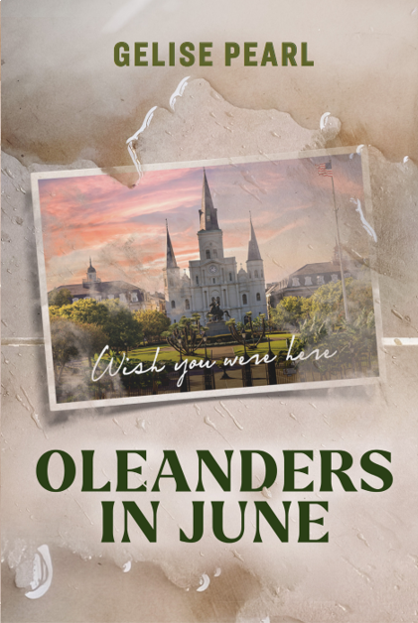
The Story Behind Oleanders in June
“The fact is, I don’t know where my ideas come from. Nor does any writer. The only real answer is to drink way too much coffee and buy yourself a desk that doesn’t collapse when you beat your head against it.”
This quote from best-selling author Douglas Adams truly captures the wondrous and challenging experience writers encounter when creating something from nothing. Of course, my historical fiction was not entirely created from my imagination. Hurricane Katrina was very real. But perhaps you’re wondering why I chose this storm as the backdrop for my story. The short answer? I didn’t.
Another quote on writing, a personal favorite, comes from author Julia Cameron (The Artist’s Way). “The creative process is a process of surrender, not control.” And nothing better describes this story than surrender.
A few years ago, I had planned to write a fictional suspense novel. I began to draft a story about a missing child from an abusive family and a therapist who broke all the rules to rescue him. The inspiration behind this story, my debut novel In Plain Sight, stemmed from my day job as a psychologist working with children. I had planned to traditionally publish this story. After hiring a developmental editor and finishing my final draft, I sent the query to dozens of literary agents (more than seventy!) over the course of two years, but never found one willing to commit.
This was not going according to plan.
If you’ve ever tried breaking into the world of traditional publishing, you know the querying process is dreadful. Not only did I receive rejection after rejection but plenty of teases, too. Some agents showed genuine interest in my story and asked to read more. Some requested the full manuscript. I even had a conversation with one agent about developing my book into a series. Sadly, none of these inquiries panned out.
Still, I couldn’t stop thinking about my characters. How real they felt. How I wanted to share them with the world. And so, I kept writing.
Somewhere along the way, I began toying with the agent’s idea of turning my book into a series. What would Marissa, Lily, and Tori—my twenty-somethings in a quarter-life crisis—be doing after In Plain Sight? Better yet, what were they doing before this story? Nothing shapes who we are today more than our childhood experiences. The psychologist in me was bubbling with curiosity. I began to imagine my characters at different life stages. Middle childhood. Forties. Highschoolers. So many prospective stories began to flood my mind, yet one age group spoke to me the most. College. The time when young adults hone their identities and embrace their new freedoms. Lily could be a freshman who had just moved to New Orleans, meeting sophomores Marissa and Tori for the first time. I could explore the ways they met and delve into their family lives and early career plans. There was so much story material here, it was perfect! I had my characters. I had my setting. All I needed was the year. In Plain Sight took place in 2011, and my characters were 24 and 25 years old. Now let’s rewind to the beginning of freshman and sophomore year, ages 18 and 19. Picture it. New Orleans. August, 2005.
Oh dear.
Hurricane Katrina had struck New Orleans on August 29, 2005, and forever changed the lives of thousands of people. The storm wasn’t part of anyone’s plans, and it certainly wasn’t part of my writing plans, but it was a significant detail of my setting’s history I couldn’t ignore. Suddenly, I was filled with ambivalence. Dread. And a strong case of imposter syndrome. A story set during Hurricane Katrina? Am I qualified to write this? Would anyone even want to read it?
For better or worse, I was beyond qualified. Katrina had impacted me in more ways than I care to recall. My home had flooded to the ceiling after the levee breaches. I was displaced to three different schools and nine temporary houses during my senior year of high school. But this wasn’t just about my story. I wasn’t writing a memoir. At one point during my undergrad at Louisiana State University, I wound up working a student research position with the Sociology Department. At the time, it was just “a job”, but it gave me invaluable insight into dozens of other stories when I went door-to-door interviewing residents on their experiences with the storm. And finally, my psychology background and years practicing in the field had given me a greater understanding of the profound effects untreated trauma had on these residents.
The second question was a little harder to answer. I carefully— painstakingly considered the risk of harm this story might cause. Many residents would not want to relive such a difficult time, especially those who lost loved ones. Still, there was another risk to consider. The risk of my silence. I was given unique insight into so many untold stories; this was an opportunity to give a voice to those residents. Even if I wasn’t documenting the true stories of the New Orleanians I had interviewed, there were common themes across these testimonies that I needed to show. These stories were filled with heroism and loss, with heartache and hope. These stories deserved an audience.
Who was my audience, anyway? Pondering this question opened my eyes to more reasons to write. I wanted to share this story with fellow New Orleanians. To bring long-awaited validation, the familiarity of shared experiences, the comfort in knowing we didn’t suffer alone. But perhaps there was another purpose.
Beyond the direct impacts of the storm and the manmade disasters that followed, Hurricane Katrina had led to a breakdown of communication, false and exaggerated news reports, and misplaced blame on those who suffered the most. Could such a story enlighten those outside the impacted areas on the real events that took place? Several other published works had done just that. One of the most well known books is Chris Rose’s 1 Dead in Attic. This remarkable collection of newspaper columns documented the events that took place after Katrina and the raw emotions so many of us experienced. In another example, Tom Piazza’s historical fiction City of Refuge showcased unique viewpoints by following the journey of a white family that evacuated before the storm and a black family that sheltered in place. If I could inform others the way Rose and Piazza had, if I could accomplish a fraction of what these books accomplished, if I could open just one person’s mind to a new perspective, this story would be worth telling.
Suddenly, a new plan began to unfold. My first book had revolved around the search for a missing child with themes of overcoming trauma. This plotting and theme would be perfect for a post-Katrina setting. As the pieces came together, I put aside my filters, I silenced the negative voices, and I began to write.
Now I had to get to know my characters on a deeper level. How would Lily, Marissa, and Tori respond to a disaster that uproots them and changes their whole world? Then came a critical question. Who would go missing? I couldn’t use someone from my first book without spoiling it. Since this was a prequel, readers of the first book would know they had survived. It was time to create someone new. But would they survive the storm? Even I didn’t know as I began writing.
Regardless of how the story would end, I had to create a character my readers would root for. I began to picture a maternal figure. Caring, yet firm. Warm. Wise. At last, Adeline McMillan, AKA Nana was born. No one can resist a loving grandmother.
With the creation of Adeline, I had everything I needed to complete this story, but one question remained. A question I dreaded answering but would have to face in the coming months. Should I seek traditional publishing again? Taking the same route as before meant querying dozens of publishers and agents, stomaching rejection upon rejection with no guarantee my story would ever get into the hands of any readers. Did I want to spend another two years trying to pass “the gatekeepers” again? While I believed this story had a profound purpose, I wasn’t sure if publishers would see it that way.
My writing peers had talked about their positive experiences with self-publishing and encouraged me to pursue it. Self-publishing? Once again, this was not part of my plans. But as I considered this alternative, it forced me to reflect on another time when things didn’t go according to plan—the bumpy road I followed to opening my own private practice (a story for another time). I realized that this experience had helped me develop entrepreneurial skills, skills I could use to start my publishing business.
One of the best things about being your own boss can also be one of the hardest. Not having someone breathing down your neck means having the self-discipline to get things started, and to finish what you started. As the fates would have it, my writing was guided by a predetermined deadline. Less than a year away was the twenty year anniversary of Hurricane Katrina, August 29, 2025. What a perfect date to publish, I told myself. When the deadline approached, however, I surrendered once again and chose not to release my book that quickly. I needed to give this story more time. Instead, I took advantage of the anniversary to launch my marketing campaign.
Over the next four months, I continued to work with the help of two Beta readers from New Orleans, a professional copy editor, a graphic designer friend, and even my husband (surprisingly helpful and objective) to finish what I started. At last, I completed the final draft and published Oleanders in June December 30, 2025.
What started as an immensely frustrating process, full of disappointments, roadblocks, and detours turned into something better than I could’ve ever planned for myself. I am proud of where those detours led me and in the end, I finished a story I truly believe in. A story with tenacious characters facing insurmountable obstacles. A story of heartache and hope. A story I had never intended to write. The moral of this story, the one you’re reading now? Be open to surrender.